Designing Off-Grid Solar & Battery for a Remote Barn Home
Converting a remote barn to an off-grid home? Here’s what to gather and decide before you ask for a solar + battery quote, from usage numbers to permits and batteries.
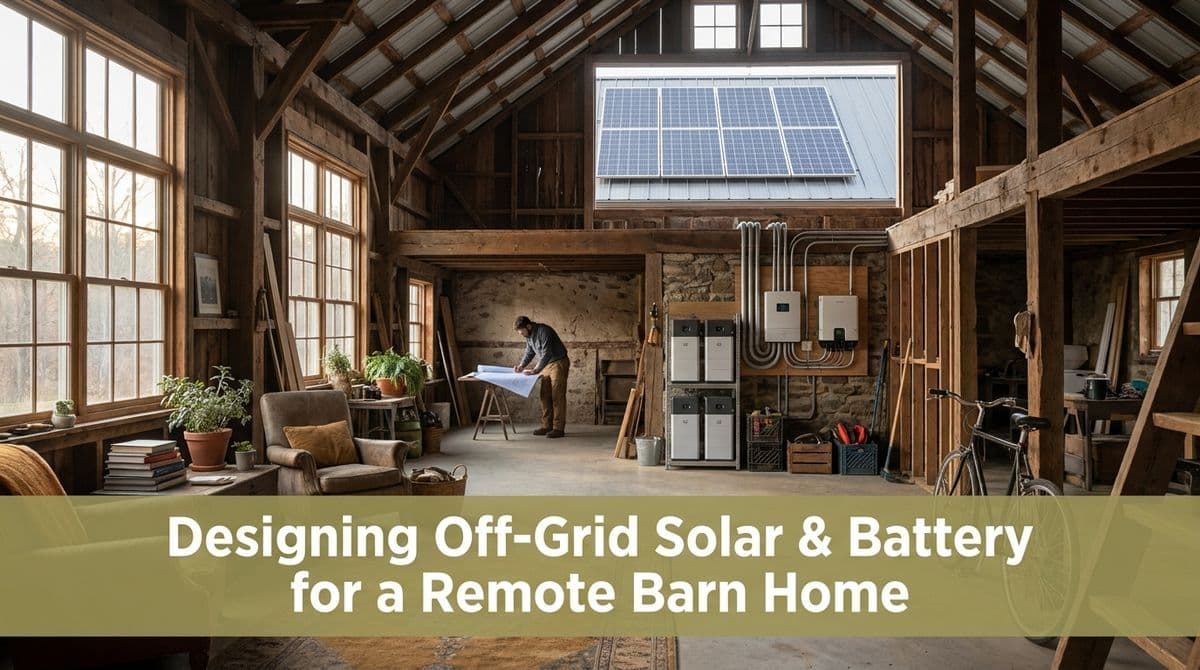
Turning a Remote Barn Into a Home With Off-Grid Solar
We recently got a call from a customer — let’s call her Megan — who was working with a landowner in remote West Texas. They’ve got a freestanding barn in Reeves County, roughly 2,000 square feet, that they want to convert into a simple residence.
The catch? There’s no grid power anywhere nearby. No meter, no address, just coordinates in the middle of oil and gas country. They wanted to know: what would it cost to run the whole place on solar panels and batteries so one person could live there comfortably?
As we talked through Megan’s questions, we realized a lot of homeowners are dreaming about the same thing — a remote barn or cabin conversion powered entirely off-grid. But before we can give a realistic quote, there are a few key things you’ll want to have ready.
Square Footage Isn’t Enough: Start With Your Energy Use
Like many callers, Megan began with the building size: “It’s about 2,000 square feet.” That’s helpful context, but for off-grid design, the critical number isn’t square footage — it’s how much electricity you’ll actually use.
When we design an off-grid solar + battery system, we’re essentially sizing you a private power plant. We asked Megan the same thing we ask everyone: “Do you have an idea of your monthly electricity use or bill where you live now?”
Here’s what we recommend you gather before you call:
- Recent electric bills from a similar home (same number of occupants, similar lifestyle).
- Average kWh per month if available, or at least an average bill amount (e.g., $200–$300/month).
- A rough list of the major electrical loads you’ll have in the barn: HVAC, refrigerator, well pump, TV, computer, washer/dryer, etc.
In Megan’s case, the plan was for one person who’d be out most of the day, with needs like HVAC, a fridge, TV, and computer. That’s a pretty modest load — but HVAC in West Texas is no joke, and that’s where most of the power planning happens.
Why Location and Coordinates Matter So Much
Because Megan’s barn didn’t even have a postal address yet, she asked if coordinates would be good enough. For off-grid projects, GPS coordinates are actually perfect — often better than an address.
Here’s why we need your exact location:
- Solar resource: We use mapping tools to estimate how much sun your site gets year-round.
- Shading and orientation: Aerial imagery tells us where to put panels and what might shade them.
- Access and logistics: Remote sites can affect installation costs, equipment selection, and scheduling.
So if you’re like Megan and your property is “out in the middle of the field,” pulling your GPS coordinates from a map app and sending them to us is an excellent start.
Key Design Questions for Your Off-Grid Barn System
Once we have your usage and location, we start asking design questions. Thinking about these ahead of time will make your quote faster and more accurate.
1. How Reliable Does Your Power Need to Be?
Some owners are okay with conserving power on cloudy days; others want the system to feel just like the grid. For a single-occupant barn like Megan’s, we usually ask:
- Do you need full power 24/7, or can you tolerate occasional limits?
- Would you consider a small backup generator for multi-day storms?
- Is the barn a primary home or more of a weekend place?
The more “grid-like” you want it to feel, the larger (and more expensive) the solar and battery bank will be.
2. What Type of Heating and Cooling Will You Use?
In a hot, dry climate like Reeves County, HVAC is often the largest electrical load. We’ll ask things like:
- Are you planning a high-efficiency mini-split or a conventional central system?
- Will you use any propane or wood for heating to reduce electrical load?
- How well will the barn be insulated and air-sealed once converted?
A well-insulated shell and efficient mini-split can dramatically shrink the solar and battery system you need, saving you money upfront.
3. Do You Need Power for Wells, Shops, or Future Buildings?
Many barns also serve as a workshop or supply power to a well pump or future guest cabin. If you think you might expand later, it’s helpful to tell us now so we can design for scalability instead of maxing out the system on day one.
Choosing the Right Battery: Chemistry and Care
When Megan asked about “solar panels and a battery,” we walked through what that actually means today. Modern off-grid systems are usually built around one of two main battery types:
- Lithium iron phosphate (LiFePO₄)
Higher upfront cost, but lighter, more compact, and longer lasting. Very little maintenance, high efficiency, and deeper usable capacity — great for full-time off-grid homes. - Flooded lead-acid or AGM
Lower upfront cost, but heavier, larger, and shorter lifespan. Flooded lead-acid batteries need regular water checks and equalization charges; AGMs need less maintenance but still don’t last as long as lithium in most applications.
For a remote barn conversion where access can be tricky, we generally recommend lithium if the budget allows. It cuts down on maintenance trips and tends to be more forgiving if usage patterns change over time.
Whatever chemistry you choose, here are a few basic battery care tips to keep in mind:
- Keep batteries in a ventilated, temperature-moderated space, not baking in direct sun.
- Design for a reasonable depth of discharge (don’t size it so you’re draining to empty every night).
- Schedule a yearly system checkup to review performance, connections, and firmware updates.
Permits, Inspections, and Code for Off-Grid Barn Conversions
One thing we always remind folks like Megan: even if you’re off the grid, you’re usually not off the building and electrical codes. Before we finalize a design, we typically help homeowners think through:
- Local building and electrical permits: County or local jurisdictions often require permits for residential conversions and electrical systems, even without a utility connection.
- Change of use: Converting a barn to a residence can trigger different structural, fire, and egress requirements compared to an agricultural building.
- Inspections: An inspector may want to see proper grounding, disconnects, clear labeling, and adherence to the National Electrical Code (NEC).
Before you call for a quote, it’s worth a quick conversation with your county or local authority to see what they expect for a barn-to-home conversion. When we know the permitting landscape up front, we can design a system that passes inspection the first time.
What to Send Us Before You Ask for a Quote
When Megan wrapped up her call, we gave her a short checklist to email over so we could build an accurate proposal. If you’re planning something similar, here’s what we’d love to see from you:
- GPS coordinates of the barn or property.
- Average monthly kWh or bill amount from a similar home.
- A list of major loads (HVAC type and size, well pump, appliances, tools).
- Whether this is a full-time home, part-time cabin, or guest space.
- Any known permitting or inspection requirements from your local jurisdiction.
With that information in hand, we can plug everything into our design software and give you a realistic system size, battery capacity, and price range — not just a rough guess.
Ready to Power Your Remote Barn Off-Grid?
Designing an off-grid solar + battery system for a remote barn is absolutely doable, but it works best when we treat it like designing a custom power plant for your specific lifestyle. Megan’s call from Reeves County is a good example: a single occupant, modest usage, hot climate, and a truly remote site.
If you’re dreaming of turning your own out-of-the-way barn into a comfortable home, gather your usage details, rough loads, and coordinates, and then reach out. We’ll walk you through options, explain tradeoffs, and help you build an off-grid setup that fits both your needs and your budget.